


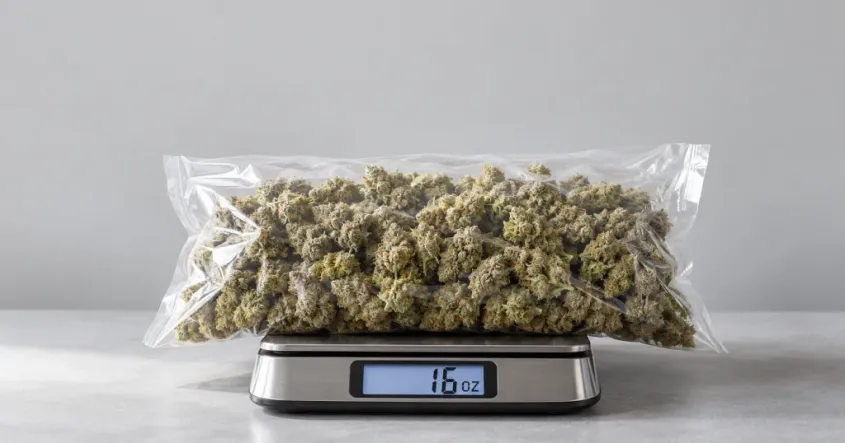
The national average price of a pound of weed is about $1,100 at wholesale in 2026, based on the U.S. Cannabis Spot Index, which sat at $1,104 in mid-October.
That’s a wholesale benchmark, so what you’d actually pay depends on where you are and how the pound changes hands. The same sixteen ounces can run $400 in one market and $4,000 in another. The gap usually comes down to three things: your state, whether the pound moved through a wholesale, legal retail, or illicit channel, and whether it’s state-regulated or adult-use cannabis.
This 2026 guide pulls those threads apart. You’ll find a national snapshot, a market-type comparison, a 50-state plus DC quick-reference table, and deeper looks at seven states where the pricing story is the most interesting. Prices vary widely, so treat every number here as a current estimate, not a quote. State laws also vary, even where federal rules stay the same.
Key Takeaways
- The U.S. Cannabis Spot Index sat near $1,104 per pound in mid-October 2026, with mid-grade wholesale typically in the $600 to $1,200 range.
- Wholesale, legal retail, and illicit-market prices can differ by 3x or more for the same flower quality.
- A pound of weed is 16 ounces, roughly 453.6 grams, or about 128 eighths at 3.5 grams each.
- State legal status is the single biggest predictor of price, ahead of quality or climate.
- In states without a legal adult-use market, hemp-derived THCA flower is a federally compliant, lab-tested alternative to illicit sourcing, subject to the current federal hemp compliance window.
What Is a Pound of Weed, Exactly?
One pound of cannabis equals 16 ounces, or roughly 453.6 grams. Broken down to retail-size portions, that is about 128 eighths of 3.5 grams each, or 16 ounces at 28 grams apiece.
A pound is a bulk quantity, not a counter purchase. Most adult-use states cap single transactions at 1 to 2.5 ounces, so a “pound” is really a wholesale or benchmark figure, not something a shopper walks out with. For a frequent adult consumer who uses an eighth a day, a pound would last about four months. For an occasional consumer, the same pound could stretch well past a year. It is a working unit for growers, retailers, and bulk buyers, not for most everyday consumers.



The Price of a Pound of Weed Right Now: A National Snapshot
The national average wholesale price for a pound of weed has held near $1,100 in 2026, with lower-grade outdoor flower trading closer to $400 and premium indoor well above $2,000. Legal retail and illicit-market prices for the same pound run meaningfully higher.
The U.S. Cannabis Spot Index rose 1.1% to $1,104 per pound as of mid-October 2026, roughly where the wholesale benchmark has held for most of the year. For context, the index stood at $1,015 per pound in April 2026, down 6.8% year-to-date after a 15% recovery in 2025 from a historic low of $888 in January 2025.
Quality tier matters almost as much as geography. The spread between outdoor biomass and top-shelf indoor is wide enough that the “average” number only tells part of the story.
| Tier | Typical wholesale price per pound | Notes |
| Lower-grade / outdoor biomass | $100–$600 | Oversupplied markets like Michigan, Oregon, parts of California |
| Mid-grade / greenhouse | $600–$1,200 | Most common wholesale range nationally |
| Premium / indoor | $1,200–$2,500+ | Smaller supply, tighter-licensed or newer markets |
Wholesale vs. Legal Retail vs. Illicit Market: Three Very Different Numbers
A pound of weed does not have one price. It has three, depending on the channel it moves through, and most pricing articles blur the lines.
- Wholesale is grower-to-retailer pricing in a licensed market. It reflects what a dispensary actually pays before taxes, packaging, and markup.
- Legal retail is a dispensary’s per-gram price scaled to a pound, even though pounds aren’t sold at the counter.
- Local supply and legal risk, not regulation, set illicit-market pricing, which is why the same flower can price three times higher a few hundred miles from the nearest legal source.
The street price for a pound of weed, in other words, is almost always higher than a comparable legal wholesale pound, because illicit pricing is built up from per-ounce risk premiums rather than discounted down from bulk. This is the opposite of how legitimate pricing structures work.
| Market type | Typical price per pound | What sets the price |
| Wholesale, licensed grower to retailer | ~600–1,800 | State regulation, cultivation method, supply |
| Legal retail, per-gram price × 453.6g | ~1,200–3,200 | Retail markup, taxes, packaging, testing |
| Illicit market | Often 3,200–6,000+ | Local supply, legal risk, proximity to a legal source |
If you want the compliant, lab-tested wholesale alternative, THCA wholesale flower sits on the legal side of that first row with batch-level pricing a buyer can verify.
Adult-Use vs. State-Regulated Cannabis Pricing: Why the Tax Gap Matters
The gap between state-regulated cannabis programs and adult-use cannabis pricing is largely a tax story. State-regulated cannabis programs are typically taxed well under 10%, while recreational/adult-use taxes commonly run in the 20% to 30%+ range depending on the state. For an otherwise identical pound, that tax wedge is often the biggest reason prices between the two markets diverge.
Florida is a useful exception to flag early. The state currently operates a limited state-regulated cannabis program with no adult-use legalization, so “recreational pricing” there is, by definition, illicit-market pricing. The same is true in every state where regulated and adult-use markets haven’t both opened: higher adult-use prices almost always reflect the absence of a legal retail option, not a quality premium.
What Actually Drives the Price of a Pound of Weed
Five factors do most of the work in moving the number.
1. State Regulation and Tax Structure
This is the single biggest lever, because the state decides who can legally grow and sell, how many licenses exist, and how much of the price goes to taxes.
Adult-use states with mature supply chains sit at the low end. Limited-access, CBD/hemp-only, and fully illegal states sit at the high end, because the pricing shoppers face there is illicit-market pricing.
Taxes widen the gap: state-regulated programs are typically taxed well under 10%, while adult-use taxes commonly run 20% to 30% or more, and Nevada stacks a 15% wholesale excise tax ($1,296 per pound of flower) on top of 10% at retail.
2. Cultivation Method
Indoor flower carries the highest production costs and also commands the highest visual quality. Greenhouse sits in the middle, and outdoor delivers the lowest cost at the highest volume.
3. Supply and Competition
Oversupplied, mature markets like Michigan and Oregon see wholesale prices collapse, while newer or tightly licensed markets like Nevada stay elevated. Price compression in mature states is now a defining feature of the national supply chain.
4. Cannabinoid Content and Aroma Profiles
Higher-THC flower with distinctive aroma profiles commands a premium at wholesale and retail. That helps explain why top-shelf indoor maintains a clear price gap over commodity outdoor, even in saturated markets.
5. Compliance Costs
Lab testing, child-resistant packaging, and seed-to-sale track-and-trace add measurable cost per pound, particularly in tightly regulated states, and they also separate a legal wholesale pound from a street pound. The same discipline applies on the hemp side: every SKU The Hemp Doctor Wholesale sells comes with a published hemp COA so buyers can see what they are getting.
If you are sourcing in bulk, our guide to what to look for when buying bulk THCA flower online walks through the same checklist from a hemp-side perspective.
Price of a Pound of Weed by State
Prices swing hard from state to state. The table below shows which market actually sets the price in each state. Seven states with the most interesting stories get their own subsection below.
| State | Legal Status | Typical Price per Pound (est.) |
| Alabama | Limited-access cannabis program | 4,200–5,600 (illicit) |
| Alaska | Adult-use legal | 1,300–2,400 |
| Arizona | Adult-use legal | 700–1,600 |
| Arkansas | Limited-access cannabis program | 4,000–5,400 (illicit) |
| California | Adult-use legal | See detailed section ↓ |
| Colorado | Adult-use legal | See detailed section ↓ |
| Connecticut | Adult-use legal | 1,400–2,600 |
| Delaware | Adult-use legal | 1,300–2,400 |
| District of Columbia | Adult-use legal* | 1,500–2,800 |
| Florida | Limited-access cannabis program | See detailed section ↓ |
| Georgia | CBD/hemp-only | 4,200–5,600 (illicit) |
| Hawaii | Limited-access cannabis program | 4,200–5,800 (illicit) |
| Idaho | Fully illegal | 4,800–6,200 (illicit) |
| Illinois | Adult-use legal | 1,400–2,600 |
| Indiana | CBD/hemp-only | 4,200–5,600 (illicit) |
| Iowa | CBD/hemp-only | 4,200–5,600 (illicit) |
| Kansas | Fully illegal | 4,600–6,000 (illicit) |
| Kentucky | Limited-access cannabis program | 3,800–5,200 (illicit) |
| Louisiana | Limited-access cannabis program | 4,000–5,400 (illicit) |
| Maine | Adult-use legal | 1,200–2,200 |
| Maryland | Adult-use legal | 1,400–2,600 |
| Massachusetts | Adult-use legal | 1,600–2,800 |
| Michigan | Adult-use legal | 630–1,800 |
| Minnesota | Adult-use legal | 1,300–2,400 |
| Mississippi | Limited-access cannabis program | 4,000–5,400 (illicit) |
| Missouri | Adult-use legal | 1,400–2,600 |
| Montana | Adult-use legal | 1,200–2,200 |
| Nebraska | Limited-access cannabis program | 4,200–5,600 (illicit) |
| Nevada | Adult-use legal | See detailed section ↓ |
| New Hampshire | Limited-access cannabis program | 4,000–5,400 (illicit) |
| New Jersey | Adult-use legal | 1,500–2,800 |
| New Mexico | Adult-use legal | 1,200–2,200 |
| New York | Adult-use legal | 1,800–3,200 |
| North Carolina | Fully illegal for marijuana; hemp THCA legal | See detailed section ↓ |
| North Dakota | Limited-access cannabis program | 4,800–6,000 (illicit) |
| Ohio | Adult-use legal | 1,600–2,800 |
| Oklahoma | Limited-access cannabis program | 3,200–4,400 (illicit, famously oversupplied regulated market) |
| Oregon | Adult-use legal | See detailed section ↓ |
| Pennsylvania | Limited-access cannabis program | 4,000–5,600 (illicit) |
| Rhode Island | Adult-use legal | 1,300–2,400 |
| South Carolina | Fully illegal | 4,600–6,000 (illicit) |
| South Dakota | Limited-access cannabis program | 4,200–5,600 (illicit) |
| Tennessee | CBD/hemp-only | 4,000–5,400 (illicit) |
| Texas | CBD/hemp-only | See detailed section ↓ |
| Utah | Limited-access cannabis program | 4,000–5,400 (illicit) |
| Vermont | Adult-use legal | 1,200–2,200 |
| Virginia | Adult-use legal* | 1,800–3,200 |
| Washington | Adult-use legal | 700–1,600 |
| West Virginia | Limited-access cannabis program | 4,000–5,400 (illicit) |
| Wisconsin | CBD/hemp-only | 4,200–5,600 (illicit) |
| Wyoming | Fully illegal | 4,800–6,200 (illicit) |
*DC has no true commercial retail market because of its gifting-model workaround, and Virginia has legalized possession and home grow but has not yet launched commercial retail sales. Both are flagged “adult-use legal” for possession, but neither has a conventional dispensary price to quote.
North Carolina
The Eastern Band of Cherokee Indians operates the state’s only true legal adult-use dispensary, Great Smoky Cannabis Company, on tribal land in the Qualla Boundary, and only for adults 21+ on that land.
For everyone outside tribal land, the price of a pound of weed in North Carolina is illicit-market pricing by definition, which we estimate at roughly $4,600 to $6,000. Hemp-derived THCA flower is openly and competitively priced through wholesale and retail hemp channels, with wholesale pounds running about $200 to $1,125+ and indoor mostly between $475 and $1,125.
California
California’s legacy legal market is now defined by oversupply. Outdoor wholesale has run roughly $300 to $650 per pound, with indoor between $800 and $1,200, near a 10-year indoor low. The average price for a pound of weed in California now sits well below where it did a decade ago, driven by a mature cultivation base and persistent competition from illicit growers.
Retail purchase limits of 28.5 grams per transaction mean a “retail pound” in California is a benchmark figure, not something you can actually buy at a counter. If you are reading per-gram prices, scale carefully.
Colorado
Colorado is the clearest story of a mature market finding a floor. The average market rate for wholesale marijuana flower fell to $649 per pound, tying an all-time record low, according to the Colorado Department of Revenue, despite a 25% reduction in licensed cultivators from September 2023 to September 2025. The average price for harvested flower has steadily declined since 2021, when prices exceeded $1,700 per pound.
Since then, it has drifted lower still. Colorado’s “Retail Bud” average market rate was $601 per pound effective October 1 through December 31, 2026, defined by the Department of Revenue as the median price of unprocessed cannabis transferred from cultivators to retail stores or manufacturers.
Nevada
Nevada runs noticeably pricier than its West Coast neighbors because it has a smaller, more tightly licensed cultivation base. The state excise tax applies 15% on wholesale fair market value, which sits at $1,296 per pound of flower, plus 10% on retail sales. The Nevada Department of Taxation publishes that wholesale number quarterly, making it the cleanest citable figure for the average price of a pound of weed in Nevada.
Even in a mature market, retailers are still ringing up a $758 million annual market, though price compression has driven tax revenue down about 40% from a 2021 peak, with flower prices off 50% since 2019. In other words, Nevada is pricier than California or Oregon, but prices are still falling.
Texas
Texas has no legal adult-use market and no broad regulated cannabis program outside the narrow Compassionate Use registry. Whatever pricing exists for recreational cannabis in Texas runs through the illicit market, where numbers are inherently unreliable and shift by region and proximity to supply routes. The average price for a pound of weed in Texas, in a street-market sense, is less a benchmark than a rumor, but a reasonable estimate is roughly $4,000 to $5,400.
Florida
Florida’s limited-access cannabis market is served by a small number of vertically integrated operators, and retail flower pricing has fallen sharply as the market has matured and oversupplied, even with a new wholesale tax introduced to stabilize the drop. For registered adult consumers in the state program, the average price of a pound of weed in Florida at retail scale has become one of the more competitive limited-access market numbers in the country.
Outside the state program, Florida pricing reflects illicit-market dynamics, not a regulated retail number, and we estimate it at roughly $4,000 to $5,400 per pound. As with Texas, the federal hemp framework currently gives operators a compliant path for hemp-derived cannabinoids, with wholesale THCA pounds running about $200 to $1,125+ (indoor mostly $475 to $1,125). That path is subject to the same December 11, 2026 window noted above and to the usual reminder that state laws vary.
Oregon
Oregon is the long-standing national low-price benchmark. Persistent oversupply has pushed outdoor wholesale flower to extraordinary lows. Oregon wholesale has ranged roughly $100 to $800 per pound, with roughly 3 million pounds unsold in storage and outdoor flower as low as $100. The average price of a pound of weed in Oregon is a useful contrast point for anyone trying to understand how far wholesale can fall when supply outruns demand.
Price of a Pound of Weed by State
Tap a state for its estimated price per pound. Darker means pricier.
Color uses the middle of each state’s range. Figures are directional estimates, not live quotes. California, Colorado, Nevada and Oregon show wholesale figures, so they read lower than states shown at legal-market or illicit prices. Cannabis and hemp laws and prices vary by state and change often. For adults 21+.
The Bottom Line
The price of a pound of weed isn’t a single number. It depends on state, market type, and legal status, and the gap between the cheapest and most expensive version of that same pound can run into thousands of dollars. Wholesale sits at the bottom, legal retail in the middle, and illicit-market pricing well above both.
For adult consumers and retailers in states without a mature legal market, or anyone sourcing in bulk, The Hemp Doctor Wholesale’s hemp-derived THCA flower offers a federally compliant, lab-tested alternative with transparent, batch-level pricing. Browse our THCA flower wholesale catalog now.
Disclaimer: This article is for informational purposes only and does not constitute legal advice. Cannabis and hemp laws vary by state and may change, including the federal hemp provisions scheduled to take effect December 11, 2026. Nothing here should be read as an absolute legal assurance. Always verify current state and federal rules before buying, selling, or possessing cannabis or hemp-derived products.
