
Quick Answer: Most THC drinks use Delta-9 THC, often sourced from hemp in products sold outside dispensaries. Hemp-derived Delta-9 THC and marijuana-derived Delta-9 THC are the same intoxicating compound; the main difference is the source plant and how the product fits within applicable hemp rules.
Cannabis infused drinks typically contain either Delta-8 or Delta-9 THC, although most beverages on the market use the latter. The cannabinoid undergoes a process called nanoemulsion technology to improve its solubility in water.
And since THC drinks have generated a buzz (pun intended) in recent years, their composition and how they come to be are worth exploring. This is exactly what we’re doing in this article to provide you the information you need and answer questions you may have.
If you’re the least bit curious about cannabis infused beverages, how they are made, and how they work, be sure to stick around until the end.
🔑 Key Takeaways
- Most cannabis-infused drinks use hemp-derived Delta-9 or Delta 8.
- THC is infused into beverages using nanoemulsion technology, which breaks the cannabinoid down into microscopic particles, making it water-soluble.
- Unlike Delta 9 edibles that take 45 minutes to an hour to kick in, cannabis-infused drinks take effect in as little as 10 minutes to 15 minutes for some products..
- Hemp-derived THC drinks have the impression of being “weaker,” but it is actually as potent as traditional marijuana-derived Delta 9 products.
What Kind of THC Is Used in Drinks?
Delta-9 is the most widely known form of THC and the dominant form used in cannabis-infused drinks. The molecule is chemically identical regardless of source, so a milligram of hemp-derived Delta-9 hits the body the same way a milligram of cannabis-derived Delta-9 does. The distinction has always been legal, not chemical.
Under the 2018 Farm Bill, cannabis sativa qualified as hemp if it contained no more than 0.3% Delta-9 THC by dry weight. Beverages are heavy. A standard 12-ounce can weighs roughly 355 grams, which means a single drink could legally hold a significant amount of THC while still staying within the 0.3% threshold.
That framework is changing. On November 12, 2025, Congress passed H.R. 5371, the Continuing Appropriations, Agriculture, Legislative Branch, Military Construction and Veterans Affairs, and Extensions Act, 2026. Section 781 of the law substantially rewrites the federal definition of hemp, and the new rules take effect on November 12, 2026.
Total THC replaces Delta-9 as the standard. The 0.3% threshold now applies to total THC, and Delta-8 THC alongside Delta-9.
Finished hemp products are capped at 0.4mg of total THC per container. That is a steep drop from the 2.5 to 10mg per can the beverage market has been built around.
Several bills are in motion that could delay, repeal, or replace Section 781 before the November 2026 enforcement date. The Cannabinoid Safety and Regulation Act, introduced by Senators Wyden and Merkley in December 2025, would replace the 0.4mg cap with a federal framework setting THC limits of 5 milligrams per serving and 10 milligrams per container for beverages.
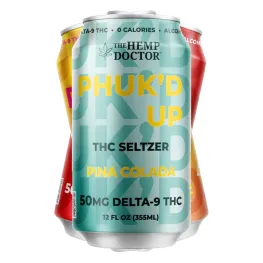
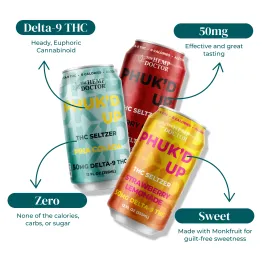
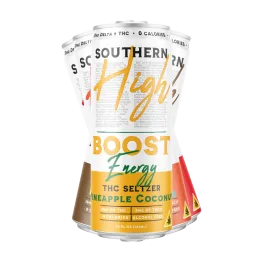
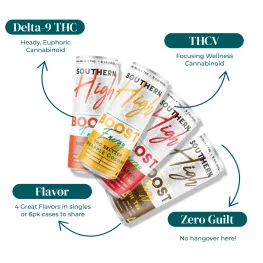

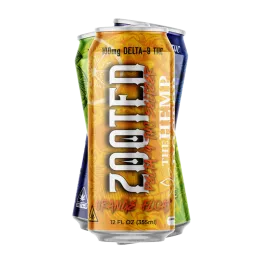
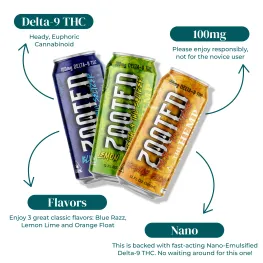
Is the THC Used in Delta 9 Drinks Real?
Quick answer: yes. Hemp-derived Delta-9 THC is the same molecule as traditional cannabis. However, there remain common misconceptions that “hemp-derived” means a “weaker,” even fake, substance. Many users may even deem it the “diet soda” of the cannabis world. Let’s debunk that myth right now.
Apart from having identical molecules, THC potency is a matter of dosage, not origin. That means hemp-derived THC, when extracted into a gummy or, in this case, a drink, provides the same psychotropic experience as traditional THC.
And through the use of nanotechnology, the THC breaks down into tiny particles. That results in a quicker, almost rapid-fire delivery that makes hemp-derived THC beverages feel as strong and potent as dispensary-grade products.

“Through nanotechnology and emulsifying agents, THC can be converted into a pure, water-soluble format, which in turn gets added to the drinks.”
Customer Service and Fulfillment Warehouse Manager
How Is THC Added to Drinks?
We’ve mentioned nanotechnology a couple of times in previous sections of the article. The process is pretty straightforward, and Lauren gets into brief detail here about how The Hemp Doctor Wholesale adds THC to its Delta 9 drinks:
“Once THC is converted into a water-soluble format, an exact dose is measured out for the product being created and blended with the pre-selected drink/liquid. After the mixture is complete, it is packaged and sent to the company.”
Nano-emulsification is considered the “gold standard” for modern cannabis infused drinks. Here, the THC oil is broken down into microscopic droplets and coated with other substances to help them remain suspended in water.
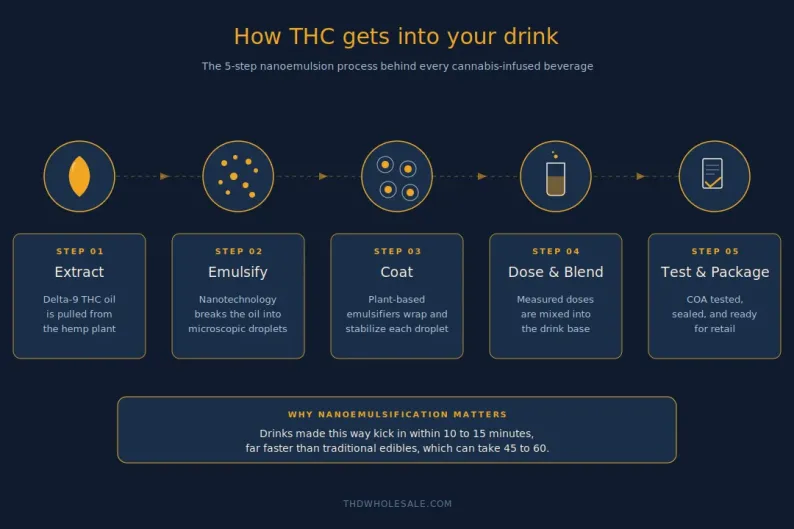
The coatings used are common plant-based emulsifiers like Soapbark, Gum Arabic, Sunflower, and Soy Lecithin, to name a few. These are necessary to keep the THC stable and evenly distributed throughout the drink without the need for shaking.
What to Look for When Buying THC Drinks?
It’s understandable to feel some confusion when buying THC drinks. Especially if you’re not used to this form of consumption, you will likely find yourself scratching your head at the dispensary counter.
Lauren’s top piece of advice is to first check out the product varieties that dispensaries offer, noting that a wider selection means a broader customer base. But more importantly, she urges look into the Certificate of Analysis (COA), label compliance, and company process.
“How the products are created is just as important as how they taste. Always be sure to choose a reliable brand that stays up to date on compliance,” Lauren said.
After you’ve done a brief background check, the next thing to look at is dosage and onset claims. If you’re a beginner, you should stick to products with at least 2.5 milligrams and no more than 5 milligrams.
These dosages allow you to enjoy THC drinks throughout the night, much like you would with alcoholic beverages such as light beers.
You should also check whether the label mentions “Nano-emulsified” or “water-soluble.” The absence of these labels may indicate a standard edible infusion, which means it can take a couple of hours for the high to kick in.
Conclusion
Cannabis infused drinks are hot commodities at the moment. Most of them are made from Delta-9 hemp-derived THC, which, contrary to popular notion, isn’t fake.
Getting top-quality THC drinks from a reputable source can sometimes be challenging. If this is a minor issue you’re facing, you can check out The Hemp Doctor Wholesale as a trusted and compliant source.
Stock compliance-ready THC beverages that are lab-tested, nano-emulsified, and clearly labeled. THD Wholesale carries a full lineup of Delta 9 drinks that pass COA scrutiny and ship with the documentation your retail customers ask for.